
How Secure Are Safe Deposit Box Facilities?
- Mar 3
- 3 min read
Updated: Mar 4
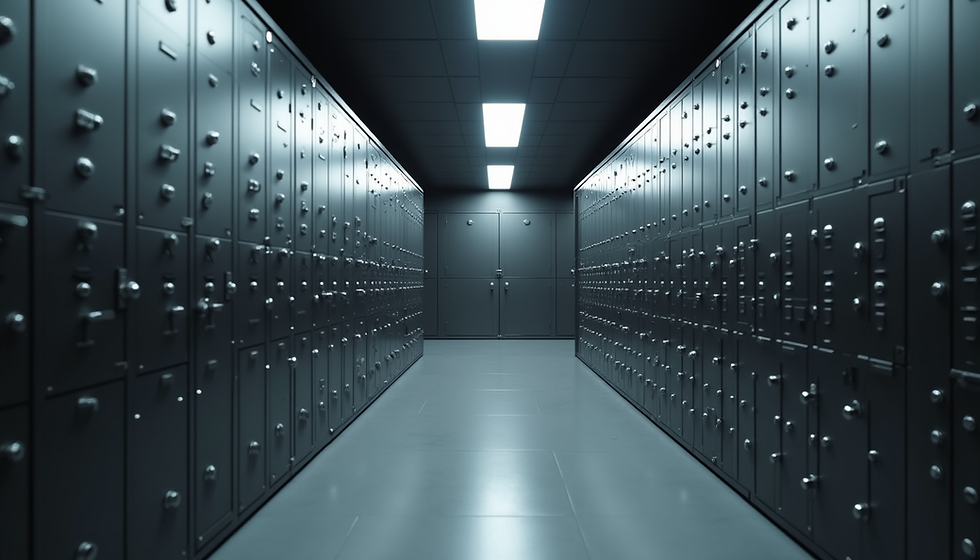
Behind the Scenes of a High-Security Vault
When people think of a safe deposit box, they often picture a small metal drawer tucked behind a bank counter. In reality, modern high-security vault facilities are engineered environments — purpose-built to resist theft, fire, forced entry, and unauthorised access.
So how secure are safe deposit box facilities really?
Let’s take a look behind the scenes of what makes a professional vault truly secure — without revealing sensitive operational details.
1️⃣ Bunker-Grade Construction
A genuine high-security vault is not simply a reinforced room. It is a bunker-style structure, typically built using:
Thick reinforced concrete walls
Steel mesh and composite materials embedded within the structure
Reinforced flooring and ceilings
Limited, strategically controlled access points
The goal is simple: eliminate weak points.
Unlike standard commercial properties, vaults are designed to resist forced entry attempts from all angles — including walls, floors, and ceilings.
This kind of construction takes significant planning, specialist engineering, and compliance with strict security standards.
2️⃣ The Vault Door: A Security System in Itself
The vault door is one of the most recognisable — and critical — components of any safe deposit facility.
High-security vault doors are typically:
Manufactured from solid steel and composite alloys
Extremely heavy (often weighing several tonnes)
Built with multi-layer locking mechanisms
Resistant to drilling, cutting, and high-impact attacks
These doors are not just “thick metal.” They are engineered systems designed to delay and deter sophisticated intrusion attempts.
Time is one of the biggest security factors in any vault environment. The longer something takes to breach, the lower the likelihood of success.
3️⃣ Advanced Alarm & Monitoring Systems
Modern vault facilities integrate layered electronic security systems, such as:
Intrusion detection sensors
Vibration and movement monitoring
24/7 alarm connectivity
CCTV coverage across controlled areas
Backup power systems
Importantly, these systems are designed with redundancy in mind. That means multiple layers operate simultaneously — if one system were compromised, others remain active.
Security isn’t one single alarm. It’s a coordinated network.
4️⃣ Controlled Access & Identity Verification
One of the most critical aspects of vault security is access control.
Professional facilities operate under strict protocols, such as:
Identity verification before entry
Dual-control systems (no one person can access a vault alone)
Segregated staff-only zones
Controlled client access procedures
Audit trails and monitored entry points
Clients access only their own safe deposit box — never the vault unsupervised.
This layered human and procedural control is just as important as physical construction.
5️⃣ Discretion by Design
Security is not only about physical strength — it’s also about visibility and exposure.
Many high-security vaults are intentionally located within discreet commercial buildings rather than high-traffic retail environments. Reduced visibility lowers risk and enhances client privacy.
True security combines:
Structural protection
Technology
Strict procedures
Discretion
6️⃣ Insurance & Risk Management
Reputable facilities also operate with structured insurance frameworks and documented proof-of-value procedures.
This ensures:
Transparency
Professional standards
Clear coverage parameters
Security isn’t just about preventing risk — it’s about responsibly managing it.
Why Professional Vault Facilities Matter
A professionally built safe deposit box facility is engineered specifically for one purpose: protecting what matters most.
Compared to storing valuables at home — even in a high-quality safe — a purpose-built vault offers:
Significantly stronger physical protection
Monitored, layered security systems
Controlled access protocols
Reduced personal risk
Final Thoughts
High-security vault facilities are not ordinary storage spaces. They are carefully engineered environments that combine structural strength, technology, strict procedures, and discretion.
While no security system in the world can claim to be “impenetrable,” professional safe deposit box facilities are designed to provide maximum deterrence, delay, detection, and protection.
For clients storing gold, jewellery, important documents, or digital assets, understanding what happens behind the scenes builds confidence — and rightly so.
Because when it comes to safeguarding valuables, serious security isn’t optional. It’s engineered.


Comments